
Oscar Eagle ; At the Nexus of Pop, Persona and Sound
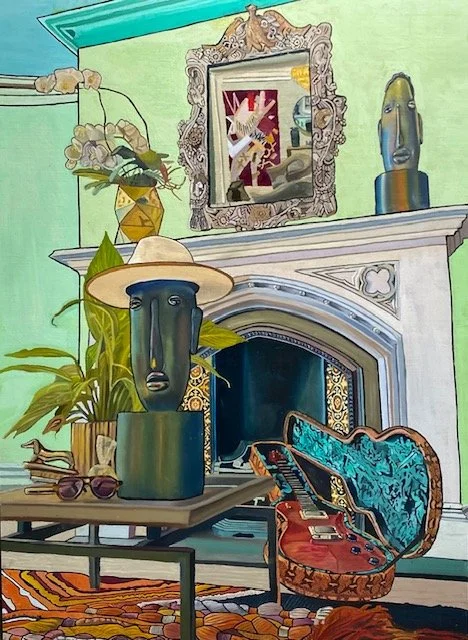
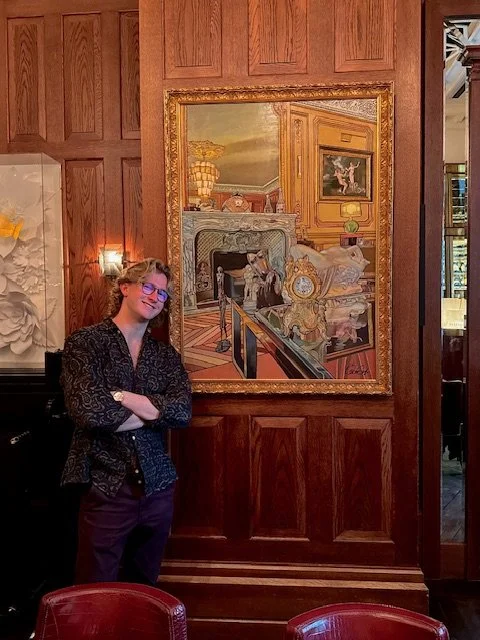
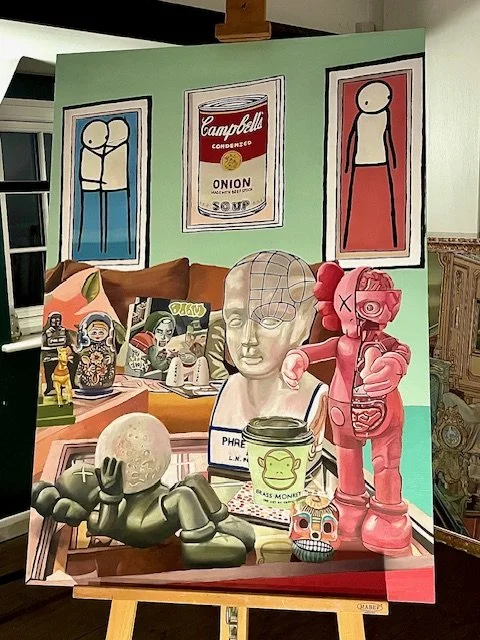
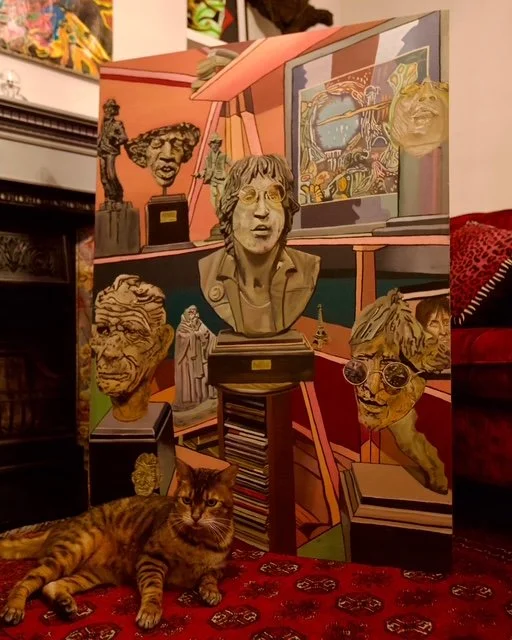
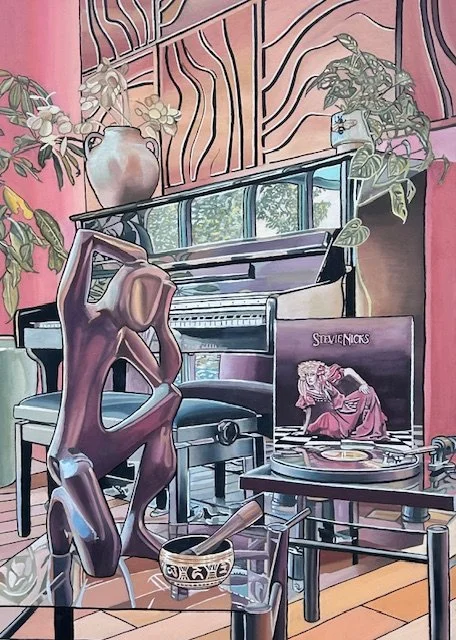
Walking into Oscar Eagle’s London studio, accompanied by Sir John Griffin, the esteemed patron who has quietly nurtured his practice, feels akin to stepping into the overture of a symphony. The space hums with possibility: canvases poised on walls, albums lingering on turntables, and the tactile energy of creation lingering in the air. In Eagle’s work, visual art and music are not parallel experiences; they are intertwined movements of the same composition, each informing the other in real-time.
Oscar Eagle is a London based artist whose practice sits within the lineage of neo-pop and hyper-realistic painting, yet he charts his own course through it. He works primarily in oil on wood, creating images that are simultaneously detailed, symbolic and emotionally charged. His oeuvre interlaces luxury interiors, cultural iconography and, increasingly, the lived experiences of the people he encounters. What feels most striking about his work is not just its visual precision but its narrative depth: paintings become visual journals, personal architectures of colour and memory that articulate an interiority rarely explored in contemporary pop art.
From Interior to Identity
Oscar’s canvases are anchored in the spaces we inhabit and the stories we tell ourselves about those spaces. Whether commissioned or created from impulse, they evoke a sense of place as a lived experience, spaces shaped by soundtracks, by attire, by the interplay of light and mood. His aesthetic is born not from detachment but from immersion: he does not paint spaces as sets, but as sites of belonging. In doing so, he marries the material and emotional dimensions of contemporary life in a distinctly original voice.
What differentiates Eagle’s work is how seamlessly it references representation without reproduction. There are echoes of Warhol’s pop-polished surfaces and of the gestural confidence of late-20th-century figurative painting, but Eagle’s visual language is his own: his compositions map identity through objects, textiles, colour fields and sonic cues. It is an art of presence, art that knows it is a record of being.
Music as Material
During my time in his studio, I witnessed how music does not merely accompany his painting, it shapes it. For Eagle, sound and visual form are in constant dialogue. Unlike artists who treat music as background ambiance, he engages with it as structural inspiration. Melodies inform rhythm; tempo informs brushwork; harmony underpins spatial relationships on the canvas. Observing him create, one senses that his paintings are compositions scaled up, where colour harmonics and visual rhythms echo the logic of a score.
This aesthetic synthesis, painting in relation to sound, engenders a sensory richness that transcends medium. It is a rare quality in a visual culture that often traps artists in rigid hierarchies of genre; Eagle dissolves those hierarchies effortlessly.
Portraits of the Soul
What Eagle is currently most absorbed by, and what makes his recent work particularly compelling, is what he calls portraits of the soul. These are not literal likenesses, but rather visual resonances derived from encounters with people: the colours they gravitate toward, the objects they cherish, the moods they emanate. This form of portraiture privileges emotional essence over physiognomy; the resulting works are evocative rather than descriptive, a poetic cartography of presence.
Such work aligns with a broader contemporary shift toward affective aesthetics, art that seeks to make feeling visible without reducing it to cliché or sentimentality. In Eagle’s hands, this becomes an exploration of shared human textures: how colour, form and gesture coalesce in the body and the psyche.
An Uncompromised Vision
What makes Oscar Eagle stand out in a crowded field is not only his artistic fluency but his philosophical commitment to authenticity. In an era when commercial pressures can distort artistic intention, Eagle remains focused on the poetics of creation rather than market metrics. His work is not produced to fit a trend; it emerges from impulse, dialogue and reflection.
Sir John Griffin’s support, providing studio space and mentorship, has allowed Eagle to sustain the integrity of this practice. Griffin’s involvement is not intrusive; it is quietly catalytic, offering space and context rather than prescription. This kind of patronage harkens back to classical models while remaining fully present in the dynamics of today’s art world.
The Experience of Encounter
A painting by Oscar Eagle is not merely something to look at, it is something to enter. Viewers find themselves inside a moment: a memory, a mood, a tension between sound and silence. The work does not simply reflect the world; it refracts it through a sensibility that feels intensely alive, personal and surprisingly universal.
His art is, in every sense, an experience: visual and sonic, intimate and expansive. Encounters with his work linger like refrains, subtle, resonant, unforgettable.
Oscar Eagle is, quite simply, an artist to watch.
